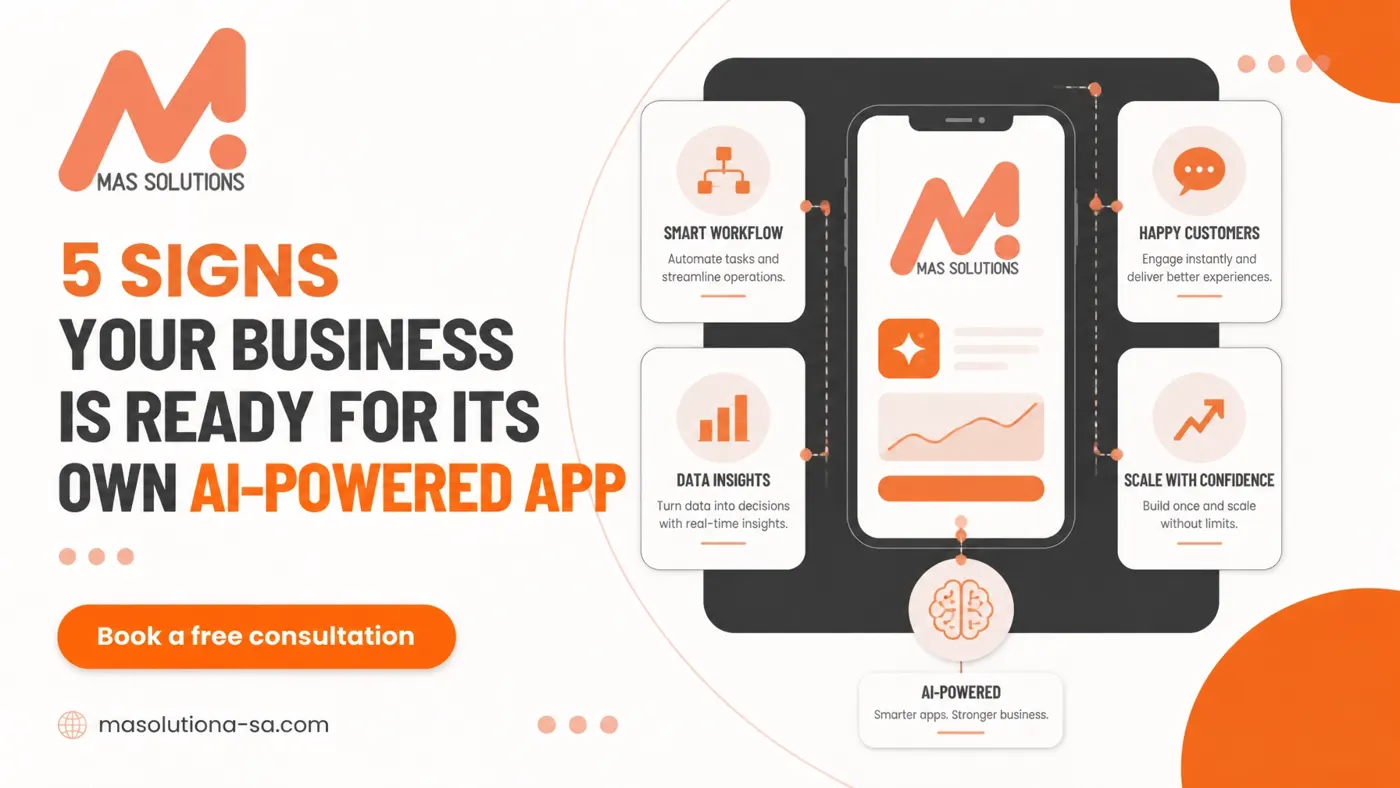
Artificial intelligence is no longer reserved for large enterprises with extensive technology budgets. For businesses across Riyadh, the Gulf, and wider MENA, an AI-powered mobile or web app can improve customer experiences, streamline operations, and help teams scale with greater control.
However, not every business needs a custom app immediately. The right starting point may be a secure customer portal, an internal workflow automation solution, or a carefully scoped minimum viable product.
The important question is not, "Can we build an app?" It is:
"What customer or operational problem should the app solve?"
At MAS Solutions, we answer that question through our customer-centric Insights → Strategy → Execution methodology. We begin with your personas, processes, data, and commercial objectives. Then we define the right digital product and execute it with measurable KPIs, regional relevance, speed, and flexibility.
Here are five practical signs that your business may be ready for its own AI-powered app.
1. Your team is spending too much time on repetitive manual work
Repetitive work is often the clearest signal that a business needs digital transformation.
Your team may be:
- Copying information between spreadsheets and systems
- Re-entering orders received through WhatsApp or email
- Preparing similar reports every week
- Manually assigning tasks or approval requests
- Answering the same internal questions repeatedly
- Updating customers one by one about order or service status
These activities may appear manageable when your business is small. As volume increases, they consume valuable time and introduce avoidable errors. They also prevent employees from focusing on work that requires judgment, creativity, and relationship-building.
An AI-powered app can help by connecting data, automating predictable steps, and presenting the next action clearly to the right person. For example, an app could extract information from a request, create a record, route it for approval, and notify the customer when the status changes.
The solution does not need to automate everything on day one. A focused first release can target the process causing the most friction.
The readiness test: If your team performs the same digital steps repeatedly and follows a largely predictable process, that workflow may be suitable for automation or an AI-enabled app.
2. Customer communication is fragmented across too many channels
Customers in KSA and MENA may contact your business through WhatsApp, social media, phone calls, email, website forms, and in-person visits. These channels are useful, but they can create operational fragmentation when there is no connected customer journey.
Common symptoms include:
- Different employees providing different answers
- Customer histories spread across separate tools
- Leads being missed after business hours
- Sales and service teams lacking the same information
- Customers repeating their details at every stage
- Slow responses to routine requests
A customer-facing app can bring key interactions into one consistent experience. Depending on your business model, it may allow customers to submit requests, view updates, receive notifications, access documents, book services, or communicate with a support assistant.
AI can add another layer of usefulness. A carefully designed assistant may help answer approved frequently asked questions, classify requests, summarize conversations, or direct customers to the correct service. It should support your team — not operate without appropriate controls or human oversight.
For Arabic- and English-speaking audiences, language readiness is essential. Where relevant, the experience should also support right-to-left (RTL) layouts, Arabic content patterns, regional terminology, and clear switching between languages.
The readiness test: If customers are repeatedly asking for updates, information, or support across disconnected channels, a unified app or portal may reduce friction and improve consistency.
3. Customers are asking for self-service
A growing demand for self-service is a strong indicator that your business may benefit from a digital product.
Customers may ask:
- "Can I track my order online?"
- "Can I book without calling?"
- "Can I download my invoice?"
- "Can I update my details myself?"
- "Can I submit a request after working hours?"
- "Can I see the progress of my application or service?"
These requests reveal more than convenience preferences. They show that customers want visibility and control over their relationship with your business.
A mobile or web app is appropriate when customers need frequent, direct interaction with your brand. A portal may be more suitable when a defined group — such as clients, partners, vendors, members, or employees — needs secure access to information and workflows.
A self-service experience can include account and profile management, order and request tracking, digital document and invoice access, appointment scheduling, service updates and notifications, knowledge-base search, and AI-assisted answers to routine questions.
The design should remain simple. The goal is not to add more features; it is to remove unnecessary steps and help customers feel smart, informed, and supported.

4. You have valuable data, but you are not using it effectively
Many businesses already hold useful data in CRMs, e-commerce systems, accounting platforms, spreadsheets, point-of-sale systems, or booking tools. The challenge is that this information is often siloed, inconsistent, or difficult to interpret.
You may know basic figures such as sales volume or customer count, yet struggle to answer more useful questions:
- Which customers need follow-up?
- Where do requests slow down?
- Which services generate the most repeat demand?
- What questions are customers asking most often?
- Which operational tasks require the most staff time?
- Where are customers dropping out of the funnel?
An AI-powered app can bring relevant data into a clearer operating layer. It may include dashboards, alerts, search, recommendations, summaries, or predictive features where the data quality and business use case justify them.
The technology should follow the decision, not the other way around. AI is valuable when it helps your team act faster, prioritize better, and serve customers more effectively. It is not valuable simply because it appears in a feature list.
Data protection must also be part of the design from the beginning. If your solution processes personal data in Saudi Arabia, your team should consider the requirements of the Saudi Personal Data Protection Law (PDPL) and obtain appropriate legal and compliance guidance. Relevant official resources include the Saudi Data & AI Authority (SDAIA) and the GOV.SA data regulation and cybersecurity framework.
Security considerations may include role-based access, secure authentication, encryption and controlled integrations, data minimization, audit trails, clear retention and deletion policies, and human review for sensitive decisions.
The readiness test: If your business has digital data that is difficult to access, connect, or interpret, an app or portal may turn scattered information into practical operational intelligence.
5. You need to grow without adding unnecessary complexity
Growth exposes weak processes.
As demand increases, businesses may face delayed responses, inconsistent service, overloaded managers, difficult onboarding, and more coordination between teams. Expanding to new cities or GCC markets can add further complexity through language, customer expectations, payment methods, and operational requirements.
An AI-powered app can provide leverage by helping your business:
- Serve more customers through structured digital journeys
- Standardize recurring processes
- Reduce avoidable administrative work
- Give customers visibility without constant staff intervention
- Connect teams around a shared source of information
- Add capabilities progressively as needs evolve
This does not mean technology replaces people. It means your people spend less time coordinating basic tasks and more time delivering value.
A modular product is particularly important for SMBs. Your first release should address a clear business priority, with an architecture that can support future improvements. This approach protects investment, improves speed to market, and avoids paying for features that customers do not need.
The readiness test: If every increase in demand requires a similar increase in headcount, manual coordination, or management effort, a digital product may help you scale more sustainably.
When should you build an app, portal, or automation solution?
The right format depends on the users and the problem.
Build an app when:
- Customers need frequent mobile access
- Notifications, location, device features, or repeat engagement matter
- You are creating a distinct, ongoing customer experience
- A mobile-first journey is central to your value proposition
Build a portal when:
- A defined customer, partner, vendor, or employee group needs secure access
- Users need documents, status updates, requests, approvals, or account information
- The experience is structured around accounts and permissions
- A responsive web solution may be more practical than a downloaded app
Prioritize workflow automation when:
- The main issue is internal repetition
- Users do not need a new customer-facing interface
- Existing systems already work but do not communicate effectively
- The priority is connecting processes, records, notifications, or approvals
In some cases, the best solution combines all three. The decision should be based on customer behavior, process complexity, existing technology, budget, and measurable outcomes.
How MAS Solutions turns readiness into execution
Our approach follows the same Three-Gear Methodology that guides our integrated marketing and communications work.
Insights
We study your customer personas, operational bottlenecks, data sources, market context, and user expectations. We identify the friction that matters most.
Strategy
We define the product scope, user journeys, technical architecture, AI role, language requirements, security considerations, integrations, and KPIs. We determine whether an app, portal, automation tool, or combination is appropriate.
Execution
We prototype, develop, test, deploy, and optimize the solution. Our process prioritizes speed, flexibility, accountability, and a clear path from first release to future capability.
This is the evolution described in our article on AI-powered apps, portals, and automation: combining more than 30 years of MarCom expertise with modern AI app development to create digital experiences that are commercially meaningful and customer-focused.
Good technology should not make your business look complicated. It should make your customers and your team feel smart.

Is your business ready for its own AI-powered app?
If three or more of these signs sound familiar, it is time to assess the opportunity: not necessarily to build immediately, but to understand the highest-value starting point.
MAS Solutions helps businesses across Riyadh, the Gulf, and MENA move from operational challenges to focused digital solutions. We combine global know-how, regional awareness, customer-centric design, and practical execution to help you innovate with confidence.
Let's turn your operational challenges into digital triumphs.
Book a free 30-minute consultation — you'll leave with a concrete plan either way.